
If you’ve ever followed through a Bible reading plan of any sort, you most probably have come across the Book of Job. As a child, I did not attempt to read past the fourth chapter, but jumped directly to the final part. Later, I managed to read through the entire book, but it was painfully repetitive and somewhat of a mystery. At least I understood the basic idea that Job was right and Job’s friends were wrong. I was sure there had to be more to this bulky section. But, for a long time, I was satisfied to hinge my understanding on a few main ideas.
It was not until recently that I began to believe that this book could give some direction on how to navigate through a confused faith. The events in Job’s life led him to feel that he had lost God as his best Friend. He longed to speak to Him again, face to face, to know why God acted the way He did, and to have the assurance that he was still accepted in God’s sight as a servant and friend. A while ago, I was going through a season where Job’s feelings became so relatable. Although my trials were microscopic in comparison to Job, I began to have some of the same questions he had. I longed to understand why my Friend had apparently betrayed and disappointed me, and how I could find Him again. I longed for a word from God to still my troubled heart, to appease all the thoughts that were chasing each other wildly, to drive away the fear and anxiety that were starting to take a grip on me, and replace it with an unshakable trust in Him. Somehow, I sensed that God’s words to Job at the end of the book might contain that soothing balm I was looking for.
When God finally showed up and spoke to Job, the poor man’s restlessness ceased. His soul could finally repose in the assurance of his Friend’s love. But what exactly did God say? At first glance, His words sound more like reproof than comfort. What was so remarkable in the divine speeches that brought back to Job the peace he so much longed for?
I was determined to obtain that peace, so I set out on a journey to discover. Unlike Job, who had to figure out things amid pain, ashes, and the harassment of his friends, my journey began with quiet mornings on a bench overlooking beautiful Lake Davos, Switzerland, and was eventually embedded into my university studies back home. As I endeavor to share my modest findings, I pray that those who read it may be led to call God their Friend, no matter what life may bring.
This will be the first in a series of blog posts dealing with what I believe is one of the main themes in the book of Job: the freedom of man.
Satan: You Have Made a Hedge
In the opening chapter of the book, we find a conversation between God and Satan that takes place in heaven. This conversation is key to understanding the rest of the book:
“Then the Lord said to Satan, ‘Have you considered My servant Job, that there is none like him on the earth, a blameless and upright man, one who fears God and shuns evil?’
“So Satan answered the Lord and said, ‘Does Job fear God for nothing? Have You not made a hedge around him, around his household, and around all that he has on every side? You have blessed the work of his hands, and his possessions have increased in the land. But now, stretch out Your hand and touch all that he has, and he will surely curse You to Your face!’
And the Lord said to Satan, ‘Behold, all that he has is in your power; only do not lay a hand on his person.’ So Satan went out from the presence of the Lord.” (Job 1:8-12)
There is a small but important word in this passage. This word creates a motif that keeps reappearing throughout the whole book. It is the word hedge.
What is a hedge? Merriam-Webster defines it as “a fence or boundary formed by a dense row of shrubs or low trees.” In a more general acceptance, it means any barrier or limit. A third definition adds the dimension of “protection or defense”; this interpretation is reflected in many Bible translations of verse 10. We usually limit our interpretation of the “hedge” to the idea of divine protection.
But what if Satan is accusing God of something deeper? What if the “hedge” that Satan claimed existed was a “built-in” hedge, an inherent psychological limitation God had seemingly embedded into His created beings? Satan was accusing not so much the fact that God was protecting Job, but that God created Job without the capacity to exercise freedom of choice.
Let me expand on this. In verse 10, Satan makes two statements about God: (1) that God has created a hedge (some kind of barrier or limit), and (2) that He has blessed Job. Then he goes on to explain how Job is preprogrammed to respond to God’s arbitrary treatment. If God blesses Job, he has no choice but to serve Him. If God removes His protection, Job will have no other choice but to curse God. Visualize this for a moment: God has arbitrarily put Job on one side of the hedge, or fence. He blesses Job, and that is why Job serves Him. Place him on the other side of the fence, and he has no choice but to curse God.
What Satan really suggests is that, in God’s government, man’s choices are dependent on outside circumstances, a philosophical idea called determinism. Free will? God’s government has no place for that. God’s government has a fence. The proof of its existence? Place Job in a different situation, and his actions will immediately reflect his inability to make free-will choices. Man is not inherently free. There is a hedge, Satan claims, and the whole universe needs to see how restrictive God’s government is.
Was not this what Satan had always tried to do? He claimed that God’s law deprived angels of their rightful liberty. “[Lucifer] promised those who would enter his ranks a new and better government, under which all would enjoy freedom” (Patriarchs and Prophets, p. 40).
Satan does not necessarily ask God to remove the “fence.” The proposal to bring calamities upon Job was meant to demonstrate that this fence exists and that it would prove God’s government faulty.
Almost immediately, Satan’s hypothesis was proved false. When Job received the news of the loss of his fortune and the death of his children, he “arose, tore his robe, and shaved his head; and he fell to the ground and worshiped” (Job 1:20).
The controversy, however, is not resolved, and the trial of a terrible illness falls upon Job. He is subjected to cruel pressure from his wife to curse God. But even this pressure is met with the same faithfulness: “‘Shall we indeed accept good from God, and shall we not accept adversity?’ In all this Job did not sin with his lips.” (Job 2:10)
Job’s immediate reaction challenged the accuser’s hypothesis about human conditioning. It became clear that the “hedge” or “fence” did not characterize God’s government, but was really what Satan was doing—pressuring Job into cursing God.
However, the issue of human freedom must stand the test of time. God gives Satan a chance to prove his hypothesis. God allows Job to be surrounded and enclosed by a “fence,” not only on a physical level, but on a psychological and social level, as well; in other words, He approves of a temporal psychological “hedge” to enclose Job’s mind. Will Job stand the test? Will he be able to overcome the psychological barrier imposed by Satan? Will he be able to choose his own way and exercise his freedom?
Job: God Has Fenced Up My Way!
Several months passed (Job 7:3). Job’s friends find him sitting on a pile of rubbish, scraping his putrefying, stinky sores. After seven days of silence, Job breaks down in heartbroken lamentation. At this point, death is preferable to life:
There [in the grave] the prisoners rest together;
They do not hear the voice of the oppressor.
The small and great are there,
And the servant is free from his master.
Why is light given to him who is in misery,
And life to the bitter of soul […]
Why is light given to a man whose way is hidden,
And whom God has hedged in?” (Job 3:18-20,23)
Notice the language he uses. Job feels hedged in, enclosed, limited, like a prisoner or a slave. He feels oppressed. God has hedged him in!
In what way did Job feel limited? What could he not do now, that he felt able to do before? In order to discover what Job was referring to by the “hedge,” we should carefully read through all his discourses. A single moment cannot hold the depth of human emotion experienced under the full weight of grief. Feelings are too complex to be unpacked all at once. So let us listen to Job:
“If He imprisons a man, there can be no release.” (Job 12:14)
“You put my feet in the stocks, And watch closely all my paths. You set a limit for the soles of my feet.” (Job 13:27)
“He has fenced up my way, so that I cannot pass; and He has set darkness in my paths.” (Job 19:8)
Poor Job! He didn’t know that it wasn’t God who imprisoned him, who fenced up his way. It was Satan, the one who accused God of setting up a fence. Job feels these limitations at a deep emotional level. In Job 6:14, he makes an allusion to just what exactly he felt he could not do. Exasperated by the lack of understanding from his friends, he exclaims,
“Devotion is due from his friends to one who despairs and loses faith in the Almighty; but my brothers have been treacherous as a mountain stream, like the channels of streams that run dry.” (Job 6:14-15, The New English Bible)
Job alluded to his own situation when he mentioned the “one who despairs and loses faith in the Almighty.” His words suggest that he was experiencing a psychological limitation to exercise faith in God. He wanted to have faith, but he could not; it was as if God Himself had imposed that limitation and taken from him the liberty to exercise faith. The “hedge” or “limitation” was between himself and God.
“I know that You will not hold me innocent.
If I am condemned,
Why then do I labor in vain?
If I wash myself with snow water,
And cleanse my hands with soap,
Yet You will plunge me into the pit,
And my own clothes will abhor me.” (Job 9:28-31)“If I am wicked, woe to me;
Even if I am righteous, I cannot lift up my head.
I am full of disgrace;
See my misery!” (Job 10:15)
Let’s unpack these words. Job feels that God’s disgrace is upon him and considers him guilty (“You will not hold me innocent”). He does not have access to God’s forgiveness (“If I wash myself with snow water… yet You will plunge me into the pit” – the NIV calls it a “slime pit,” in other words, God will make him dirty again by throwing Job back into a muddy pit). Although he would gladly and willingly exercise faith in God, Job feels that God has removed that liberty from him; he feels that God has condemned him to stay at a distance from Himself and will make it impossible for Job to be restored to His favor (“If I am condemned, why then do I labor in vain?”).
Before his trial, Job’s worldview was based on freedom (we will unpack this in a later article); God made human beings free to choose to serve Him or not. He had gladly chosen to serve God and have faith in Him. But now? What had happened now? Why is he feeling like he doesn’t have the freedom to believe in God anymore? Job was filled with confusion. Is man truly free? Does he have the capacity to choose his own faith? Can man reach out to God, even when the Almighty is blocking up his way to Him? Can faith stand against an an outside force as powerful as GOD HIMSELF?
What Job was experiencing at a mental and emotional level was really a reflection of the great controversy that began in heaven between two opposing worldviews: is man truly free, or does God arbitrarily decide for him? Job goes through an existential crisis; everything he once believed about a relationship with God based on freedom hangs by a thread. And the pain of losing it is almost unbearable.
Job: I Shall Hold on My Way!
As the conversation progresses, Job begins to rise above this “confinement,” claiming and hoping for an audience with the Most High. These glimmers of hope from Job are interspersed among his other expressions of pain, confusion, and fear, but they are there nonetheless, as evidence of the existence of free will, the origin of which he acknowledges as divine:
“Though he slay me, yet will I trust in him:
but I will maintain mine own ways before him.” (Job 13:15, KJV)“Also now, behold, my witness is in heaven, and my record is on high.
My friends scorn me: but mine eye poureth out tears unto God.
O that one might plead for a man with God,
as a man pleadeth for his neighbour!” (Job 16:19-21)
Job’s speeches seem confusing to us, because they actually express the two opposite feelings which he was experiencing. On the one hand, he feels that God has built a hedge between them, and on the other hand, Job expresses faith that he will be granted a personal audience with God. These ambivalent feelings sound like “different voices” in Job’s mind. This is the reason why one can find such different emotions expressed in one single chapter, like chapter 19:
Behold, I cry out of wrong, but I am not heard:
I cry aloud, but there is no judgment.
He hath fenced up my way that I cannot pass,
and he hath set darkness in my paths.
He hath stripped me of my glory,
and taken the crown from my head.
He hath destroyed me on every side, and I am gone:
and mine hope hath he removed like a tree.
He hath also kindled his wrath against me,
and he counteth me unto him as one of his enemies. […]Oh that my words were now written!
oh that they were printed in a book!
That they were graven with an iron pen and lead in the rock for ever!
For I know that my Redeemer liveth,
and that he shall stand at the latter day upon the earth:
And though after my skin worms destroy this body,
yet in my flesh shall I see God:
Whom I shall see for myself, and mine eyes shall behold,
and not another; though my reins be consumed within me.” (Job 19:7-11,23-27)
Gradually, Job begins to sense the temporary nature of his inner conflict, that his mental suffering is just a trial. Chapter 23 contains perhaps the most sublime and hopeful plea in defense of the freedom of his words and ways:
“Oh that I knew where I might find him!
that I might come even to his seat!
I would order my cause before him,
and fill my mouth with arguments.
I would know the words which he would answer me,
and understand what he would say unto me.
Will he plead against me with his great power?
No; but he would put strength in me.
There the righteous might dispute with him;
so should I be delivered for ever from my judge.
Behold, I go forward, but he is not there;
and backward, but I cannot perceive him:
On the left hand, where he doth work, but I cannot behold him:
he hideth himself on the right hand, that I cannot see him:
But he knoweth the way that I take:
when he hath tried me, I shall come forth as gold.
My foot hath held his steps, his way have I kept, and not declined.
Neither have I gone back from the commandment of his lips;
I have esteemed the words of his mouth more than my necessary food.” (Job 23:3-12)
Yet even this beautiful plea in defense of man’s freedom is once again followed by the feeling of “being hedged in,” a condition that was apparently ordered by God:
“But he is in one mind, and who can turn him?
and what his soul desireth, even that he doeth.
For he performeth the thing that is appointed for me:
and many such things are with him.
Therefore am I troubled at his presence:
when I consider, I am afraid of him.” (Job 23:13-15)
Job’s Captivity Removed
Interestingly, the Book of Job ends with the removal of Job’s captivity or confinement—the hedge that Satan had placed on him:
“And the Lord turned the captivity of Job.” (Job 42:10, KJV)
Job’s trial is described as a form of captivity. Job had been physically and emotionally harassed at the devil’s will, and in one sense, had been his captive. However, in his innermost soul, Job held on to his identity. The story of Job is a testimony to the fact that, no matter the external circumstances, man cannot be truly made captive. God has created man free, and this free will was Job’s to exercise.
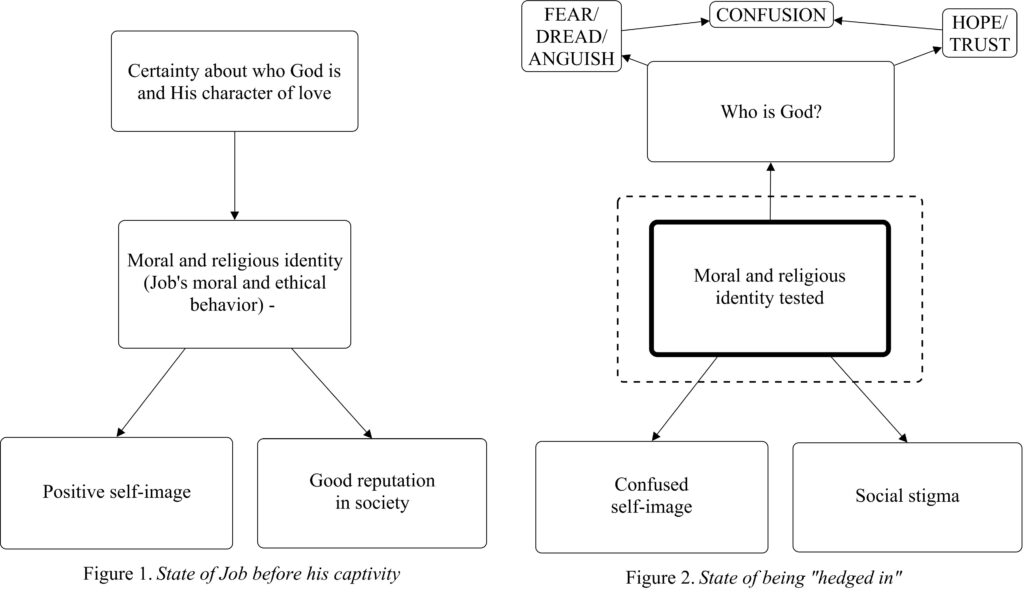
At the beginning of the narrative, Satan claims that man is “hedged in” and that his moral and religious identity is arbitrarily determined by an external source—God. Well, the Lord allowed such a “hedge” to be built up and surround Job, both physically and psychologically, in order to reveal whether man was created with the freedom to choose his own identity.
Throughout Job’s speeches, we as readers will sometimes find it difficult to determine whether Job is truly maintaining his faithfulness to God or not. This is due to the many times Job voices the feeling of being “hedged in” or psychologically pressured. On top of that, he also uses hyperbolic and passionate language in order to express those emotional processes. Yet throughout the whole book, one fundamental premise is clear: Job is determined in his heart to walk faithfully before God, just as he has done in the past (Job 17:9).
His emotional distress stems from the fact that God seems to be rejecting him. Even in the hypothetical scenario of guilt (10:14, 15), Job finds no valid reason for this rejection. He feels unable, by any means—including the possibility of forgiveness—to regain God’s favor (9:30, 31). This raises the question that troubles Job the most: Who is God? Everything he knew about God—His goodness, forgiveness, protection, and care—has been thrown into confusion and darkness. The possible answers to the question of who God is, fill Job with fear and dread. These feelings of anxiety and fear alternate with trust in the justice and mercy of the One who will bring his case to judgment (16:19–21).
Even in the face of God’s apparent rejection and the terrible fear that tests him throughout the story, Job retains his identity; he will continue to serve God. Job has not changed his ways or his moral identity, but is merely pressured to do so at the deepest psychological level.
Once it was demonstrated that no psychological barrier could alter a person’s moral identity, the “captivity” was turned or removed. This refers both to his psychological captivity and to the circumstances that brought about that mental state.
Thus, the “hedge” or psychological confinement that Job experiences turns out to be a temporary trial, permitted by God, to prove a profound truth: a person’s faith cannot be restricted, even when God apparently confines it. Man was created a free being, with a conscience that can survive even the most intense psychological pressure.
In the next article, we will look at Job’s relationship with God before his state of captivity. How did it look like? What were the thoughts and feelings Job experienced in his happy days with God, his best Friend?
An Encouraging Thought
“To all who are reaching out to feel the guiding hand of God, the moment of greatest discouragement is the time when divine help is nearest. They will look back with thankfulness upon the darkest part of their way. ‘The Lord knoweth how to deliver the godly.’ 2 Peter 2:9. From every temptation and every trial He will bring them forth with firmer faith and a richer experience.” (The Desire of Ages, p. 528)